The son of an Indian father and an American mother, Akash Kapur spent his formative years in India and his early adulthood in the United States. In 2003, he returned to his birth country for good, eager to be part of its exciting growth and modernization. What he found was a nation even more transformed than he had imagined, where the changes were fundamentally altering Indian society, for better and sometimes for worse.
To further understand these changes, he sought out the Indians experiencing them firsthand. The result is a rich tapestry of lives being altered by economic development, and a fascinating insider’s look at many of the most important forces shaping our world today. Much has been written about […]
Indien gibt viele Rätsel auf. Als Reiseland und als Exporteur von Bollywood-Filmen wird es immer beliebter, ökonomisch schlägt es alle Wachstums- und Entwicklungsrekorde. Doch wer sind »die Inder«? Gibt es eine gemeinsame indische Identität, die eine Milliarde Menschen teilen? Dieser Band bietet ein facettenreiches Porträt, das zeigt, wie sich elementare Aspekte der indischen Gesellschaft wandeln: der Stellenwert der Großfamilie, das Kastenwesen oder die Vorstellungen von Körper und Körperlichkeit, die auf dem System des Ayurveda basieren.
From Indian vultures to Chinese bees, Nature provides the ‘natural services’ that keep the economy going. From the recycling miracles in the soil; an army of predators ridding us of unwanted pests; an abundance of life creating a genetic codebook that underpins our food, pharmaceutical industries and much more, it has been estimated that these and other services are each year worth about double global GDP. Yet we take most of Nature’s services for granted, imagining them free and limitless …until they suddenly switch off. This is a book full of immediate, impactful stories, containing both warnings (such as in the tale of India’s vultures, killed off by drugs given to cattle, leading to an epidemic of rabies) but also […]
Bioenergie boomt. Ob als Pellets, Biodiesel oder Biogas, die Nachfrage nach Energie aus Biomasse steigt und steigt. Nicht zuletzt des Klimas wegen, wird den sympathischen Energieträgern doch eine ausgewogene Ökobilanz nachgesagt. Und politische Zielvorgaben, Förderprogramme sowie der steigende Ölpreis heizen die grüne Goldgräberstimmung weiter an. Doch welche Folgen hat die steigende Nachfrage für Wälder, Felder, Wiesen? Tritt der Anbau von Energiepflanzen auf begrenzt vorhandenen Flächen nicht in unmittelbare Konkurrenz zur Nahrungsmittelproduktion, wie die jüngsten Meldungen über steigende Lebensmittelpreise nahelegen? Und bedeutet nicht jede Neugewinnung fruchtbarer Böden die Rodung von Wäldern, sei es am Amazonas oder in Indonesien? Wie positiv ist die Klimabilanz wirklich und welche Auswirkungen sind für Artenvielfalt und Naturschutz zu befürchten? Ist Bioenergie wirklich eine Alternative zu […]
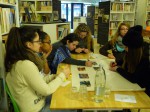
Im Rahmen ihres “Journée de Solidarité” besuchte eine Schulklasse des “Ecole Privée Fieldgen” das CITIM am 26. Februar, um an einem Workshop rund um das Thema Handy und Rohstoffausbeutung teilzunehmen. Ausgehend vom Handy und den darin enthaltenen Rohstoffen lernten die Schülerinnen Einiges über die Konsequenzen des Bergbaus für die Menschen im Osten der DR Kongo. Mithilfe von Filmauschnitten, das Erstellen einer Foto-Story, sowie weiteren Gruppenaktivitäten wurde schnell klar, dass wir als Konsumenten, Einfluß auf das Leben von Menschen in anderen Teilen der Welt haben. Im letzten Teil des Workshops wurden gemeinsam konkrete Handlungsmöglichkeiten und Lösungsansätze ausgearbeitet und besprochen. […]
An unprecedented land grab is taking place around the world. Fearing future food shortages or eager to profit from them, the world’s wealthiest and most acquisitive countries, corporations, and individuals have been buying and leasing vast tracts of land around the world. The scale is astounding: parcels the size of small countries are being gobbled up across the plains of Africa, the paddy fields of Southeast Asia, the jungles of South America, and the prairies of Eastern Europe. Veteran science writer Fred Pearce spent a year circling the globe to find out who was doing the buying, whose land was being taken over, and what the effect of these massive land deals seems to be. […]
Hier finden Sie die aktuellen pädagogischen Angebote und Tools zum Thema Globales Lernen
_______________________________
Info
Centre d'Information Tiers Monde
136-138, rue Adolphe Fischer
L-1521 Luxembourg
Heures d'ouverture ma-ve 12h00 à 18h00
sa actuellement fermé
sur rdv lu-ve 9h00 à 19h00
Fermeture estivale en août et fermeture de Noël
_______________________________
Ce site utilise des cookies afin de vous assurer la meilleure expérience d'utilisation. OkEn savoir plus
Privacy & Cookies Policy
Privacy Overview
This website uses cookies to improve your experience while you navigate through the website. Out of these cookies, the cookies that are categorized as necessary are stored on your browser as they are essential for the working of basic functionalities of the website. We also use third-party cookies that help us analyze and understand how you use this website. These cookies will be stored in your browser only with your consent. You also have the option to opt-out of these cookies. But opting out of some of these cookies may have an effect on your browsing experience.
Necessary cookies are absolutely essential for the website to function properly. This category only includes cookies that ensures basic functionalities and security features of the website. These cookies do not store any personal information.
Any cookies that may not be particularly necessary for the website to function and is used specifically to collect user personal data via analytics, ads, other embedded contents are termed as non-necessary cookies. It is mandatory to procure user consent prior to running these cookies on your website.